
A Royal Expectation
Welcome to ‘Horses and People in Art’, a regular column where we explore the history of horsemanship in art through the lens of rider position, equitation science, horse management and key horse world issues.
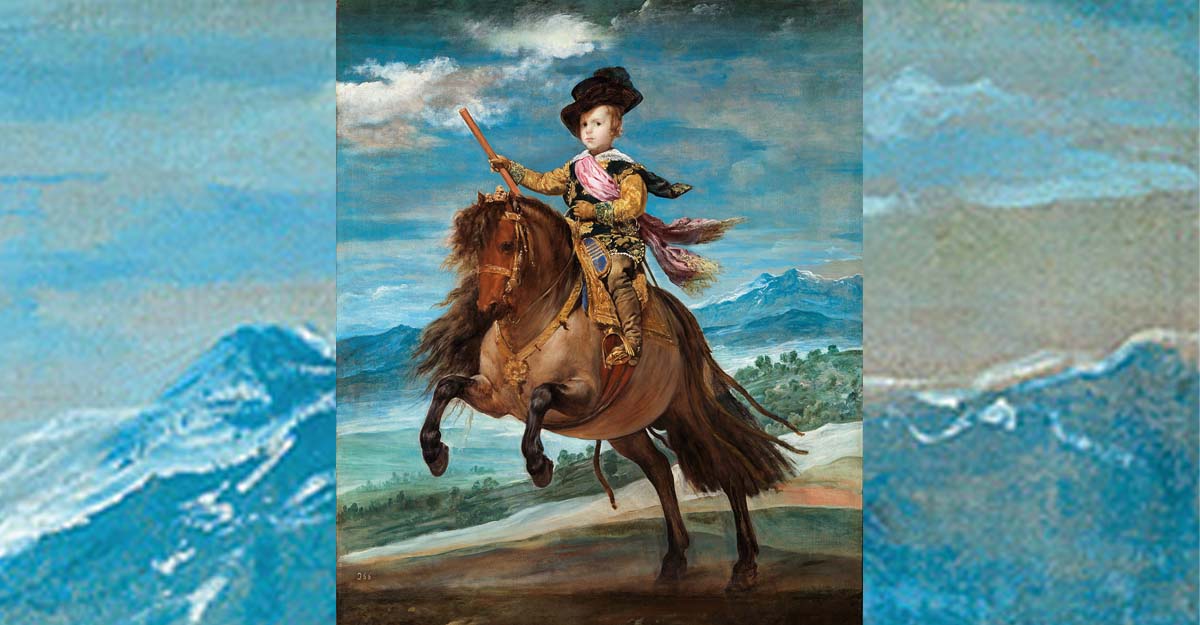
Velazquez’s Equestrian Portrait of Prince Balthasar Charles is not only a masterpiece, but an image that evokes, for the present-day horsey viewer, the pleasure of seeing small children riding their ponies with confidence.
The little rider here is Prince Balthasar Charles, the only son of King Philip IV of Spain and Elisabeth of France. Aged six at the time of this portrait, he died 10 years later of smallpox. An eerie sense of unease, almost a foretelling of early death is suggested by the lowering sky, brewing storm and grim snow-capped peaks in the background landscape around Madrid, Spain.
The Prince was known for his prowess as a rider, and here we see him performing the levade or perhaps the terre à terre (a rocking horse movement performed on the spot) on his delightful dun dressage pony, the ‘Crown’ pony, as the circlet of gold between his ears suggests. The pony’s barrel seems vast, but it was intentionally exaggerated as the portrait was intended to be seen from below.
Balthasar Charles wears a silk, velvet and gold-embroidered hunting habit and the soft suede knee-high boots that were the hallmark of a ‘cavalier’. He brandishes the baton of a Field Marshal.
The Prince’s leg position is similar to that of a modern day rider, which indicates he is riding in the ‘à la jineta’ style, used for dressage, hunting and bull fighting. At this time, there was another leg position also in style, the ‘à la brida’ [to the bridle] method, that is familiar to us from equestrian portraits of knights in armour. In ‘à la brida’, the rider rode with a stiff straight leg and very long stirrups – a position believed to be effective for controlling cavalry chargers while wearing heavy armour in the battlefield.
Capable riders were expected to be proficient in both styles and echoes of ‘à la brida’ style can be traced through from the Conquistadors to the modern American cowboy.
The Prince displays a deep seat, perfect balance and quiet hands that indicate both talent and the excellent tuition in art of dressage he was getting from the Royal Riding Master, Don Gaspar de Guzman who, in turn, was inspired by the many treatises on riding that were being published in the 17th Century, the most famous being Antoine de Pluvinel’s “Instruction of the King in the Art of Riding” of 1625.
Proficiency in haute école (high school) riding, including ‘airs above the ground’, was an essential element in the education of young noblemen, and mastery of equitation was often used to symbolically convey masterful leadership and command over a kingdom, as we see here in this exquisite work in which so much Royal expectation, unfulfilled, rode on small shoulders.