
Editor’s Note
In academic publishing, it is common—and important—for research findings to be followed by formal commentaries, replies, and further discussion. This process of critical exchange allows methods, interpretations, and conclusions to be examined openly, strengthening both the evidence base and public confidence in it.
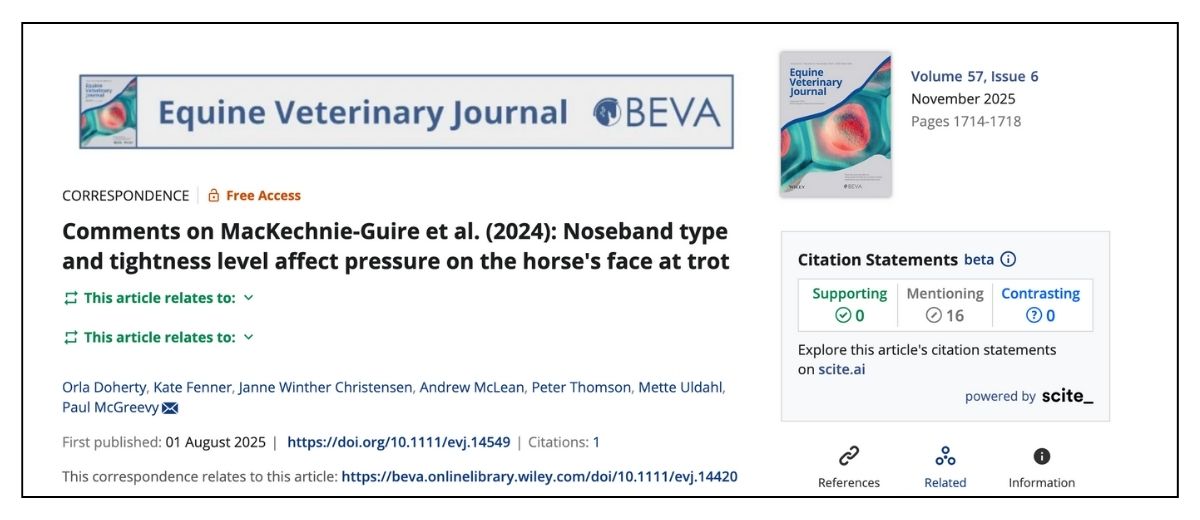
The correspondence below was submitted to the Equine Veterinary Journal as a reply to MacKechnie-Guire et al.’s response to our published commentary on their study of the effect of noseband type and tightness on the horse’s face at trot. In their reply, the authors addressed some technical points but left several key methodological and interpretive concerns unresolved.
Following normal academic convention, we sought to clarify these concerns to promote transparency and to help readers follow the reasoning behind the ongoing discussion. The letter reproduced here is that submission, which the journal declined to publish.
While we respect the editor’s decision, we believe that open scrutiny and dialogue are essential to scientific progress, particularly in areas that inform animal welfare policy. By publishing the correspondence here, we aim to make the record complete and accessible to readers who value transparency and rigour.
The full letter appears below, with detailed tables presented as collapsible sections for ease of reading.
Dear Editor,
MacKechnie-Guire et al.¹ open their response by stating that Doherty et al.² “assert that our study compromises equine welfare, a statement that we refute.” This framing is misleading. Doherty et al.’s central concern was that using MacKechnie-Guire et al.’s study conclusions to inform policy could compromise welfare by providing false reassurance about noseband tightness levels, not that the research process itself was harmful. Our critique explained why the results should be used with caution when informing regulations and how similar studies could be improved methodologically.
Their reply adequately addressed only 4 of our 9 major stated concerns. The extent to which each of our critiques was accurately represented and addressed is presented in the following tables that reveal a pattern of incomplete scientific engagement which generally fails to meet standards expected in peer-reviewed discourse.
- Table 1 deals with 3 issues that were not addressed,
- Table 2 deals with 5 issues that were partially,
- Table 3 deals with 1 issue that was fully addressed.
Table 1. Misrepresentation of the critique and responses to aspects of the critique that did not address the issue. Click on the red icon to expand.
| Our actual critique | MacKechnie-Guire et al. representation of our critique | MacKechnie-Guire et al. response | Our final comments |
| Swedish noseband pressure concerns: “Swedish noseband showed concerning pressure levels (minimal mandibular pressures 2.18 times higher than cavesson) warranting stricter regulation or potential ban.” | [Doherty et al.] “Raise concerns that our report overlooked the seemingly high pressures associated with the Swedish noseband and recommend that its use should be banned” | [Doherty et al.] “Argued no statistically significant differences were found and therefore no ban of Swedish nosebands is warranted. Noted that pressures only significant at 0.0 finger setting are “specifically not recommended.” | Circular reasoning, using inadequate statistical methodology to dismiss documented 2.18 times pressure increases. The welfare concern is dismissed based on the same flawed statistical approach we flagged up in our commentary. |
| Literature review completeness: “Omission of relevant literature including radiographic evidence of bony deformation and relationship among noseband tightness and rein tension.” | [Doherty et al.] “Raise concern that we omitted relevant studies evaluating the impact of nosebands on equine comfort” | MacKechnie-Guire et al. dismiss Pérez-Manrique et al. study as not directly measuring noseband tightness or providing causal evidence. They note different population (Mexican cavalry horses).” | Selective dismissal of relevant evidence. Other omitted studies and welfare parameters not addressed. The broader pattern of literature gaps remains. |
| Regulatory basis concerns: “Regulatory recommendations based on single study with methodological limitations and non-significant findings are inappropriate, especially given welfare implications.” | [Doherty et al.] “Are opposed to revisiting noseband regulations beyond what has ‘traditionally been deemed acceptable'” | MacKechnie-Guire et al. defend their study as providing “necessary evidence base” for FEI tool development. They argue against “traditional” approaches and emphasised their equipment and expertise. | This response mischaracterises our welfare concerns as an opposition to progress. It does not address the core issue that single studies with small samples sizes, non-significant results and methodological flaws, including failure to include treatments in the opposite direction, should not drive regulatory policy, especially when regulations have profound welfare implications. |
Table 2. Responses to aspects of the critique that partially addressed the issues. Click on the red icon to expand.
|
Our actual critique |
Authors’ representation of our critique |
Authors’ response |
Final comments |
|
Statistical power concerns: Despite documenting substantial pressure increases (49% average force increase between 2.0 and 1.5 fingers), the study failed to detect statistical significance, suggesting inadequate study power or design flaws. |
“No significant differences were found between 2.0 and 1.5 finger equivalent tightness” |
Reanalysis excluding drop noseband data still shows no significance. Acknowledge “considerable ranges” and “widely spread data” but attribute these to noseband design differences. |
MacKechnie-Guire et al. acknowledge high variability but fail to explain how a 49% force increase could be statistically undetectable in a properly powered study. Their acknowledgment of “widely spread data” directly validates our concern about inadequate experimental design. |
|
Pressure measurement methodology: Averaging pressures across all loaded sensors under-represents actual pressures at bony prominences (nasal bones and mandibular rami) where tissue damage is most likely. |
“Pressures averaged over the entire pressure mat under-represent the absolute value of the nasal and mandibular pressure” |
Clarified that only sensors >5 kPa were included in analysis, refuting suggestion about averaging with zero-pressure areas. |
This clarification is helpful, though concerns remain about whether averaging pressure values from across the 16 by 4 cm length and width of the pressure mat adequately represents peak pressures at specific anatomical sites. |
|
Pressure threshold interpretation: Worryingly high pressure levels (up to 200 kPa in some cells, exceeding systolic blood pressure) were not adequately highlighted or discussed in welfare context. |
“Use the minimal values for the Swedish noseband when adjusted to 0.0-finger equivalent tightness to suggest that we have overlooked ‘worryingly’ high pressures” |
Contextualized pressures by comparing to temporomandibular joint mechanical nociceptive thresholds (500-600 kPa), arguing their maximum pressures (32.9 kPa) are “15 times lower.” |
This comparison is inappropriate – temporomandibular joint pain thresholds cannot be extrapolated to sustained pressure beneath nosebands on different tissues. To do so ignores duration effects and tissue vulnerability differences. |
|
Statistical methodology appropriateness: Statistical analysis using non-parametric methods may not have been optimal; mixed modeling approaches considering horse and rider clustering would have been more appropriate. |
Not directly represented |
Defended non-parametric approach as “very satisfactory alternative” for skewed data with smaller sample sizes, citing Kitchen (2009). |
While non-parametric methods can be appropriate, this does not address whether the study was adequately powered or whether mixed modeling would have been superior for this study that clearly involved a repeated measures design with multiple clustering factors. |
|
Real-world applicability concerns: Study design limitations including use of only snaffle bits, non-randomized noseband order, and short trial duration (20 strides) limit real-world applicability. |
“Place disproportionate emphasis on the use of nosebands exclusively in high-level dressage horses” and suggest study relevance limited by snaffle bridle use |
Defended snaffle use as representing “broader scope” beyond elite dressage. Acknowledged some limitations (rein tension data loss, ethical committee requirements for non-randomized order). |
Response mischaracterises our concern as focused on the elite rather than methodological. The double bridle is of concern because the volume of two bits increase the risk of horses being motivated to open their mouths and fight back against noseband pressure. Key issues (trial duration, lack of double bridle comparison for policy relevance) remain inadequately addressed. |
Table 3. Responses to aspects of the critique that fully addressed the issues. Click on the red icon to expand.
| Our actual critique | MacKechnie-Guire et al. representation of our critique | MacKechnie-Guire et al. response | Our final comments |
| Data pooling methodology concern: “Inclusion of drop noseband data alongside other noseband types was problematic due to different anatomical interactions and consistently lower pressures that likely influenced pooled results.” | [Doherty et al.] “Question the inclusion of the drop noseband in our study and data analysis” | MacKechnie-Guire provided reanalysed data excluding drop noseband showing median values slightly increased but no significant differences between 2.0 and 1.5 finger settings.” | The reanalysis confirms our position: Even without the drop noseband data, the same methodological problem persists: substantial documented pressure increases are reported as having no statistical significance. |
MacKechnie-Guire et al.’s response addresses some technical clarifications and we warmly welcome their re-analysis, but it fails to resolve the fundamental methodological concerns that compromise the study’s reliability for regulatory guidance. Their stance mischaracterises our welfare-focused critique as opposition to research progress.
Core methodological issues remain unresolved
The central problem persists in that, despite documenting substantial pressure increases, the study failed to achieve statistical significance. MacKechnie-Guire et al.’s acknowledgement of “considerable ranges” and “very widely spread” data directly validates our concern about inadequate experimental control rather than resolving it. A well-designed and appropriately powered study should reveal meaningful differences when documenting 30-81% pressure increases between tightness settings.
Data pooling methodology: MacKechnie-Guire et al. dismiss documented 2.18 times pressure increases for Swedish nosebands by citing “no statistically significant differences.” This circular reasoning overlooks that their statistical methodology appears inadequate to detect the substantial differences they documented. Using statistical outcomes to dismiss welfare concerns exemplifies the inappropriate interpretation we criticized.
Regulatory implications inadequately addressed
MacKechnie-Guire et al. note their work informed International Equestrian Federation (FEI) policy development, making methodological rigour all the more crucial. Their response does not address our fundamental concern: that studies with significant methodological limitations should not drive regulatory decisions affecting horse welfare. The precautionary principle suggests that documented pressure increases warrant conservative interpretation, regardless of statistical significance achieved through potentially underpowered methodology.
Mischaracterisation of welfare concerns
To confirm, our commentary did not assert that conducting MacKechnie-Guire et al.’s study itself harmed horses or compromised welfare during the research process, as the horses were exposed to high noseband pressures for very short time durations. Instead, our critique focused on methodological and interpretive concerns around inadequate evidence, flawed statistical approaches, inappropriate conclusions, and the risks of using such evidence for regulatory guidance. We reiterate that our commentary was primarily designed to improve the quality of future related studies and ensure that welfare policy is based on methodologically robust evidence.
Recommendations
Future noseband pressure research should include:
- Proper power analysis to ensure adequate sample sizes for detecting meaningful pressure differences
- Validated measurement protocols with appropriate statistical methods for repeated measures designs
- Treatments in both directions to include the possibility that noseband tightness levels above two fingers may improve horse welfare
- Conservative welfare interpretation acknowledging that absence of statistical significance does not equal absence of biological or welfare significance
- Open sharing of data to enable re-analysis and meta-analysis of data
- Comprehensive literature integration rather than selective citation
- Precautionary regulatory approach avoiding policy changes based on single studies with methodological limitations
Conclusions
While MacKechnie-Guire et al. provide some welcome clarifications, they fail to resolve the fundamental methodological limitations that compromise their study’s reliability for regulatory guidance. Their continued reliance on statistically non-significant findings to dismiss documented substantial pressure increases demonstrates the very problem we identified: inappropriate conclusions drawn from inadequate methodology.
We maintain that this study, as conducted and interpreted, provides insufficient evidence for regulatory guidance and may inadvertently compromise horse welfare through false reassurance about noseband tightness levels.
Signed:
- Orla Doherty, UCD School of Veterinary Medicine, University College Dublin, Dublin, Ireland
- Kate Fenner, School of Agriculture and Food Sustainability, Faculty of Science, University of Queensland, Brisbane, Queensland, Australia.
- Janne Winther Christensen, Department Animal and Veterinary Sciences, Aarhus University, Aarhus, Denmark.
- Andrew McLean, Equitation Science International, Tuerong, Victoria, Australia.
- Peter Thomson, Sydney School of Veterinary Science, Faculty of Science, University of Sydney, Sydney, New South Wales, Australia.
- Mette Uldahl, Vejle Equine Practice, Vejle, Denmark.
- Paul McGreevy, Sydney School of Veterinary Science, Faculty of Science, University of Sydney, Sydney, New South Wales, Australia.
Correspondence:
Paul McGreevy, Sydney School of Veterinary Science, Faculty of Science, University of Sydney, Sydney, New South Wales, Australia.
Email: paul.mcgreevy@sydney.edu.au
Funding Information: There are no funders to report for this submission.
Author Contributions: Orla Doherty: Conceptualization; writing – original draft; writing – review and editing. Kate Fenner: Writing – original draft; writing – review and editing. Janne Winther Christensen: Writing – original draft; writing – review and editing. Andrew McLean: Writing – original draft; writing – review and editing. Peter Thomson: Statistical analysis; writing – review and editing. Mette Uldahl: Writing – original draft; writing – review and editing. Paul McGreevy: Conceptualization; writing – original draft; writing – review and editing; supervision.
References:
- MacKechnie-Guire R, Murray R, Williams JM, et al. Response to comments on: Noseband type and tightness level affect pressure on the horse’s face at trot. Equine Vet J. 2025. https://doi.org/10.1111/evj.70085
- Doherty O, Fenner K, Winther Christensen J, et al. Comments on MacKechnie-Guire et al. (2024): Noseband type and tightness level affect pressure on the horse’s face at trot. Equine Vet J. 2025. https://doi.org/10.1111/evj.14549
- MacKechnie-Guire R, Murray R, Williams JM, et al. Noseband type and tightness level affect pressure on the horse’s face at trot. Equine Vet J. 2024;57:1-15. https://doi.org/10.1111/evj.14420