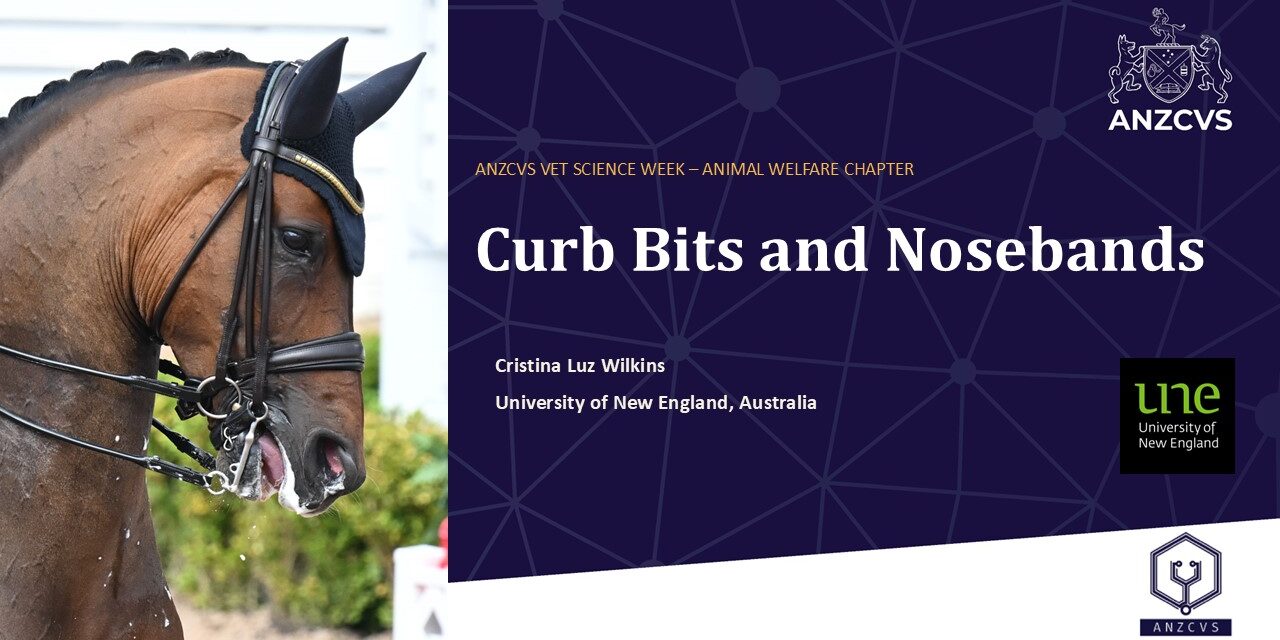

Every piece of equipment we put on a horse’s head is engineered to apply and manipulate pressure. That was the starting point for a presentation delivered last week to the Animal Welfare Chapter of the Australian and New Zealand College of Veterinary Scientists (ANZCVS) at Vet Science Week.
Speaking on curb bits and nosebands, University of New England PhD candidate and Horses and People editor Cristina Wilkins argued that a large photographic dataset from elite dressage competition shows something the industry has been able to avoid confronting: that the forces bits and nosebands apply can, and often do, exceed the biological limits of the tissues they act on.
The dataset at the centre of the talk was assembled by Norwegian fine art photographer Crispin Parelius Johannessen, whose images of cyanotic tongues at the 2024 Amsterdam World Cup drew international coverage. When those images were dismissed as manipulated or as unrepresentative “moments in time”, Johannessen was invited to join the research team, along with Finnish veterinarian Dr Kati Tuomola, whose PhD examined bit-induced oral lesions.
Johannessen photographs the field of play at up to 120 frames per second, capturing eight to ten thousand images per horse-rider combination from entry to exit. “What is rare in this dataset is not the compressed tongue,” Wilkins told delegates. “What is rare is a meaningful rein release.”
Wilkins analysed the equipment through the teleonome framework she and colleagues published earlier this year, working across six lenses: Ancestry, Adaptation, Affordances, Affect, Allostatic load and Agency. Horses evolved to use the head and neck to feed, socialise and escape, she explained — which is precisely why controlling the head and neck has been the foundation of harnessing horses for millennia.
The curb bit received particular attention. Because the curb chain wraps the mandible at the chin groove, the bit traps and compresses the tongue between the mouthpiece and the bars, with the lever design giving the rider a substantial mechanical advantage. Wilkins demonstrated the action using a curb bit on her own leg.
Her most pointed argument concerned agency. Where negative reinforcement depends on release, the images show rein tension maintained regardless of how far a horse flexes. Every attempt a horse makes to resolve the pressure — shortening the neck, opening the mouth, shifting the tongue — is mechanically blocked. “When nothing the horse does changes the outcome, the options collapse from resolving to enduring,” Wilkins said. “That is the opposite of the harmony the sport claims to be showcasing.”
She cautioned against reading compliance as comfort: the absence of rearing or baulking in horses who keep performing is not evidence that pain and fear are absent.
The One Welfare implications extend to people. Under FEI rules, a judge’s most important task is to keep the horse’s welfare in mind and penalise signs of discomfort. If that is not happening, Wilkins suggested, either the task is impossible as currently structured, or officials are not seeing the horse the way researchers do — questions her PhD is now pursuing.
Watch the full presentation below.