What Wild Horses Teach Us About Welfare and Behaviour

Image by Nancy Clarke
I wait for the horses.
As first light begins to soften the intense glow of the stars from a bright black night, I settle in, nestled and hidden within a rocky outcrop overlooking a waterhole in one of the most remote places on Earth.
The Mongolian steppe stretches out before me, the horizon endless. Wind moves unhindered across open ground, carrying the sound of hooves, a sound that has echoed here for millennia.
Equids have shaped and been shaped by this land through time, their presence woven into the rocks, the plants, and the open skies they move beneath.
These hooves tread ancient paths. Movement is not scheduled or contained; it unfolds according to weather, food availability, social dynamics, choice, and some decisions we can never fully know.
Far away, on the Atlantic edge of Scotland, Eriskay ponies make their lives among peat, rock, salt air, and shifting light. The ground is entirely different, the constraints more immediate, yet the bodies moving across it ask the same quiet questions of the world beneath them.
These horses live worlds apart, and yet their bodies speak a shared language, one that becomes especially visible where body and landscape meet. Hooves are not static structures; they are living, adapting records of how a horse meets their world.
They hold stories of terrain and distance, of loading and rest, of constraint and opportunity. They reflect not only the surface they land on, but the life that moves above them, joints, muscles, physical state, and the horse’s lived experience of the world
A hoof is a hypothesis about the ground beneath it, and the body above.
More than metaphor, this idea brings science, history, and welfare into a single frame.
In science, a hypothesis is not a claim or a certainty, but a well-tested question, one that remains open to new information and ongoing feedback. Good listening begins there: with careful questions and a trained way of seeing.

Image by Jean Sinclair
Ethology as a way of seeing
I want to be clear from the outset: I am not a formally trained ethologist, and I am not “doing ethology” in the academic sense.
Ethology is a scientific discipline, with its own methods, standards, and specialist training. It involves rigorous, systematic study of behaviour, often over long periods of time, and careful contribution to a wider scientific body of knowledge. That work matters deeply, and it deserves respect.
What I am doing here is different.
I am working with ethological principles, the ideas, methods, and fundamental structures that ethology offers, and applying them as a way of building perspective. Not as a shortcut to expertise, and not as a substitute for science, but as a disciplined way of seeing that can help us think more clearly and act more responsibly on behalf of horses.
Ethology can sound like something reserved for specialists: lab coats, Latin names, long words, and even longer papers. In practice, its foundations are much simpler, and far more practical, than that.
At its core, ethology is the careful study of behaviour in context, grounded in the ecological and social landscapes that shaped a species over evolutionary time. It asks us to observe what an animal does, when it happens, and how behaviour shifts as conditions change. It begins with description rather than judgement, staying close to the animal’s lived experience instead of rushing towards labels, explanations, or solutions.
Learning to apply an ethological perspective does not require formal scientific training. What it asks for is quieter, and in many ways more demanding: a commitment to learning how to see well. To question assumptions. To slow down interpretation. To invest time in careful observation, and to build a personal framework grounded in evidence, context, and humility.
This way of working returns confidence and responsibility to the people who care for horses, not by offering answers, but by strengthening the ability to think well in the presence of complexity.
Frans de Waal once described ethology as a “language of understanding” (de Waal, 2017) . In practice, this points to a way of making sense of behaviour that moves beyond human centred shorthand, inherited beliefs, and confident claims about what horses are like or why they behave as they do. Instead, it asks us to stay closer to what is actually happening: when behaviour occurs, what precedes it, what follows, and how it changes with context. This is where meaning begins to emerge.
That is what draws me to ethology, not as an academic identity, but as a discipline of attention. A way of learning to stay with what horses are showing us, without collapsing too quickly into labels such as “good”, “bad”, “naughty”, “lazy”, “dominant”, or “fine”. And without putting human words into their mouths, something that rarely helps, and often obscures far more than it reveals.

Image by Jean Sinclair
The Equine Blueprint
The ethologist Konrad Lorenz offered a perspective that still feels powerfully radical: living beings do not arrive as blank slates. He wrote that our cognitive and perceptual categories are adapted to the environment “for the same reasons that the horse’s hoof is suited for the plains before the horse is born.” ( Konrad Lorenz, 1941/1973, p. 99).
In other words, a horse arrives not with beliefs or instructions, but with a body already oriented toward a particular kind of world, an equine blueprint, if you will.
That blueprint is not a set of learned behaviours or conscious expectations. It is biological organisation, genetic predisposition: a body structured in such a way that certain actions are compelled rather than chosen. Behaviour carries evolutionary memory. It is not a decision about how to behave, but an expression of how the organism is built to meet the world.
When the conditions of life align closely enough with this organisation, bodies and behaviour tend to settle with a sense of coherence and ease. When they do not, the organism is forced to live in contradiction to its own design. The body remains oriented toward conditions it is organised to meet, even when the world does not provide them.
Sometimes that contradiction passes unnoticed.
At other times, it appears as dysfunction, physical or behavioural, that draws attention to imbalance.
Because a horse’s body is organised for a particular kind of world, welfare is not an abstract standard but the lived experience of how well that world meets the body they inhabit.

Image by Nancy Clarke
Welfare as lived experience
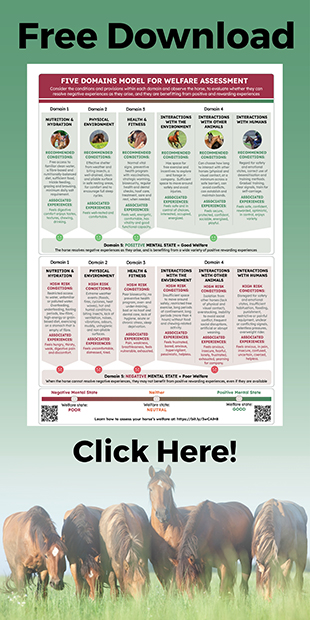
Modern welfare frameworks have helped widen the conversation beyond survival. Models such as the Five Domains (Mellor et al., 2020) encourage us to consider not only nutrition, environment, and health, but behavioural interactions and the horse’s mental state, the felt experience shaped by all the rest.
But even the best frameworks don’t tell us what matters to horses.
They ask us to find out.
And that finding out is where the horse world often falters, despite the abundance of disciplines, training methods, and endlessly evolving theories. Horses are still so often judged through human values: ideals of usefulness, compliance, productivity, or “good behaviour”. We inherit rules about what horses should be like, along with techniques for shaping them into what we want them to do.
Much is said about what is natural. But too often, that understanding is framed as something to be adopted rather than examined, delivered by systems, methods, or experts, instead of an understanding built through structured, thoughtful observation.
An ethological perspective offers something different. It does not replace one authority with another. It gently re-orients attention back towards where meaningful understanding of horses emerges, from careful observation, species-specific context. Well-grounded ethological research gives people the confidence to engage with that knowledge for themselves.

Image by Jean Sinclair
The Problem of Missing Baselines
Science begins not with certainty, but with a deceptively simple act of orientation: establishing a baseline. Without it, the familiar can quietly stand in for the healthy, and the common for the normal.
In the horse world, domestic management systems are often so widespread that they fade into the background and become normal. We inherit systems we no longer question. Stabling. Restricted movement. Predictable routines. Fragmented social lives. Limited foraging choice.
When these conditions are treated as “just how it is”, they begin to define our reference point. Behavioural adaptation can look like personality. Coping can masquerade as quirks.
We wouldn’t attempt advanced mathematics without first learning our times tables. Yet in the horse world, we often try to make sense of complex behaviour, welfare, and training questions without a clear grounding in who horses are as a species, beyond the familiar shorthand that they are “flight animals”.
There is truth in that description, but it is incomplete, and often misleading.
Horses are not defined primarily by fear or flight. They have not evolved to spend their lives constantly running across open plains. The majority of their time is devoted to building and maintaining social relationships, negotiating proximity, coordinating movement, resting together, grazing alongside one another. A more accurate starting point is to understand horses as highly social animals, living in complex, multi-level societies (Maeda et al., 2021), with a flight response that is available when needed, not a state they live in.

Image by Nancy Clarke
Coping in a World That Doesn’t Fit
In domestic contexts, we often come to “know” horses through moments of heightened arousal, spooking, rushing, aggression, explosiveness. We are taught to see them as dangerous, reactive, half a ton of muscle waiting to flee. But these are not expressions of who horses are at their core; they are stress responses, shaped and amplified by the conditions we place around them.
When people encounter wild and free-living horses for the first time, what often strikes them is the calm atmosphere. A steady, unhurried way of moving through the day. A sense of cohesion and harmony that can feel revelatory. It highlights how far many domestic systems have drifted from the kinds of worlds horses are adapted to inhabit.
In some respects, we are now working with a horse we have helped to create, through management, expectation, and constraint, and then built systems around that version, rather than beginning with who horses are, and asking how our systems might better meet them there.
When we skip that foundation, we ask horses to adapt again and again, while expecting them to thrive in worlds that make little reference to their species-specific needs. And when they struggle, we reach for methods, labels, or explanations, rather than pausing to ask whether our reference points were sound in the first place.
A horse can be well-fed and medically managed yet live in a world that makes little sense to their biological blueprint. Another may appear “bombproof”, quiet, compliant, easy, while quietly shutting down, disconnecting, or navigating low-grade discomfort that never quite earns a diagnosis.
Without a clear baseline, adaptation is easy to misread.
Sometimes what we describe as easy is simply quiet compromise.
A slow horse is often labelled lazy. Sometimes that story is comforting, it lets us stop looking. But when we hold the realities of equine life in mind, slowness begins to read differently. It may be temperament. More often, it reflects capacity: a body guarding against strain, discomfort shaping movement, a system adapting quietly to limits we have not yet recognised.
And every case deserves careful attention rather than acceptance or dismissal.
Ethology does not replace welfare thinking. It gives welfare something firmer to stand on: careful observation of how horses respond to the lives we place around them, and the confidence to ask better questions, and to know where meaningful answers can be found.

Image by Jean Sinclair
Baselines, not ideals
This is one of the places where wild and free-living horses matter, not as an ideal to copy, and not as a romanticised alternative, but as a reference that helps recalibrate our sense of what a happy and healthy horse can look like. They help us ask better questions, shifting the frame from “Does this work?” to “Does this make sense to a horse?”
Wild horses face hardship: weather, hunger, injury, loss. Life on the steppe or the hill is not always gentle.
Yet there is congruence and clarity there, movement threaded through the day rather than confined to a window and managed; social lives negotiated in real time; rest taken when it is needed; hooves shaped by real ground, real distance, real variation.
Not better.
Not pure.
Simply informative.

Image by Jean Sinclair
The practical power of an ethological approach
This is the part that matters most to me, how can we best help horses?
An ethological approach does not require formal scientific training. What it asks for instead is a commitment to learning how to become a good observer, to question assumptions, to invest time in careful observation, and to build a personal framework grounded in evidence, context, and humility.
It asks for willingness: to slow down, to look again, to widen the frame, and to keep the horse’s experience at the centre of our thinking.
It shifts the question from fixing behaviour towards understanding it, and from seeking the right answer towards learning how to ask better questions.
When that question is held steadily, different possibilities begin to appear. Not instant answers, but clearer next steps. Not the outsourcing of authority, but the steady confidence that comes from thinking well, especially when situations are complex and uncertainty is real.

Image by Jean Sinclair
Returning to the ground
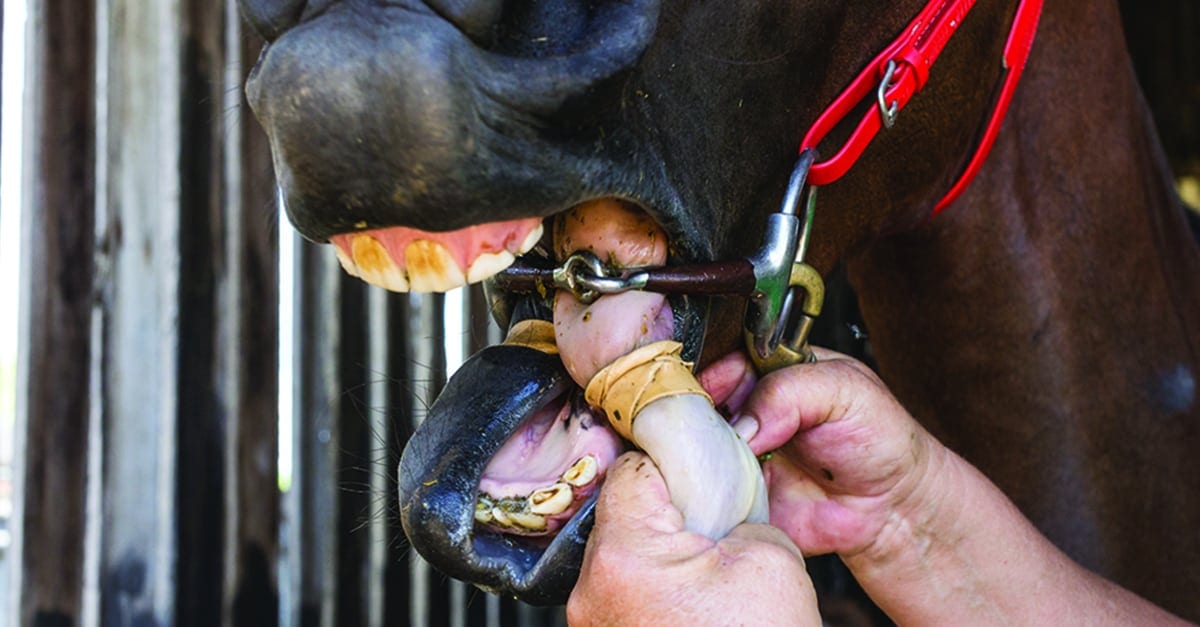
Hooves are where my eyes are drawn time and again, I can’t help myself, they are one of the most honest places to begin, because they record reality without opinion.
A foot carries the imprint of the world it has been living in, the miles travelled or denied, the surfaces covered, the movement allowed or restricted, the body’s quiet compensations.
On the steppe, hooves are sculpted by dryness, abrasive ground, and long distances travelled, built from within by desert plants and mineral-rich soils. They are high-functioning hooves, shaped by necessity in an uncompromising landscape.
On Eriskay, a pony navigates rock and peat with the same quiet intelligence. In both places, bodies continue their long conversation with the ground beneath them, adapting, responding, remembering.
Before we ask what we should do with horses, it may be worth asking something simpler, and far more challenging:
What kind of world are their bodies built for, and how closely does ours come to meeting it?

Image by Jean Sinclair
Click here to learn more about the Touching Wild Academy.
References
- De Waal, F. (2017). Are We Smart Enough to Know How Smart Animals Are?. W. W. Norton & Company, New York.
- Lorenz, K. (1941; English translation 1973). Biological epistemology.
- Quoted passage from p. 99, translated from the original German.
- International Takhi Group.
- Save the Wild Horse. https://savethewildhorse.org/en/
- Mellor, D. J., Beausoleil, N. J., Littlewood, K. E., McLean, A. N., McGreevy, P. D., Jones, B., and Wilkins, C. (2020). The Five Domains Model: Including human–animal interactions in assessments of animal welfare. Animals, 10(10), Article 1870. https://www.mdpi.com/journal/animals
- Maeda, T., Sueur, C., Hirata, S., Yamamoto, S. (2021). Behavioural synchronisation in a multilevel society of feral horses. PLOS ONE, 16(10). https://journals.plos.org/plosone/article?id=10.1371/journal.pone.0258944