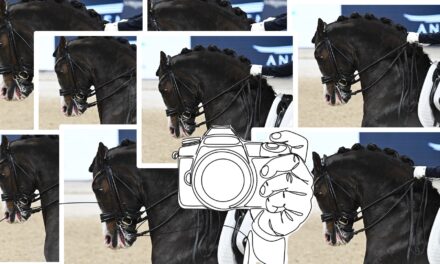
The heated debate over the FEI’s “blood rule” has centred on whether a “scratch” or a “bite of the tongue or lips” should automatically disqualify a horse or whether officials can declare such a horse ‘fit to compete’ if it’s no longer bleeding. But this legalistic argument misses a far more important welfare question: where is the affected area?
After all, a small cut, bruise, or area of redness on the coronet or front of the pastern of any jumping horse would immediately raise “hypersensitivity” alarm bells, because that area might strike a pole during the round.
Hypersensitivity (properly called hyperalgesia) happens when an injured area becomes extra-painful – when the nerves around a wound turn up the volume to shout “don’t touch me!” It’s the body’s built-in alarm system to protect damaged tissue from further harm, a biological way of forcing rest and recovery.
Jumping riders know this very well. Under existing FEI jumping regulations, hypersensitivity has been regulated because it is a fairness issue. It is explicitly prohibited because it enhances performance, and but deliberately causing injury to a horse so as to make them more ‘careful’ is inherently unethical and contrary to sportsmanship principles.
But when it comes to the mouth, flanks, or other parts of the body that flex, stretch, or come into contact with any tack or any part of the rider’s body, the same logic seems to evaporate. If the FEI already recognises the welfare and integrity risks of hypersensitive tissue in the legs, why is the same reasoning not applied elsewhere?
As the saying goes, what’s good for the goose should also be good for the gander.
The blood rule should therefore not be limited to the mouth, nose, or spur area. It should be grounded in risk of contact—whether the affected tissue is likely to be rubbed, pressed, pinched, or otherwise stressed during the normal course of competition. This is a simple, risk-based welfare principle, and it does not depend on proving whether the injury was caused intentionally or by accident.
That distinction—between intentionality and risk—is precisely where the FEI’s current framework falters. The system is built to identify and punish “abusers,” rather than to protect horses from further harm. The moment a lesion is discovered, the welfare question should be separate from the legal one. Officials should assess risk, not blame: if the damaged area is likely to be touched by anything, the horse should not continue, regardless of how the injury occurred. The investigation and penalties can come later.
Which brings us to the other elephant in the room: Risks of nosebleeds.
Another glaring omission in the discussion has been the failure to acknowledge that, in sport horses, a small, apparently minor nosebleed could signal a much more serious underlying condition. In racing jurisdictions such as Australia and Hong Kong, any sign of blood in a nostril triggers immediate investigation for Exercise-Induced Pulmonary Haemorrhage (EIPH), with mandatory scoping and rest periods. Horses with recurrent EIPH are permanently stood down. Given that around 75% of racehorses show some degree of EIPH, the assumption should always err on the side of caution.
When Olympic horse Kilkenny finished his round in Tokyo with blood pouring from his nostrils, officials felt they could not intervene because they had no blood rule. Later, the media stories and press releases named it a case of “epistaxis” and declared that the horse “made a full recovery.” But recovery misses the point. The issue was not whether he survived the episode, but whether officials acted to mitigate an evident and high-risk welfare problem. In any other safety-critical environment, such inaction would constitute negligence.
The FEI has taken steps toward more consistent, evidence-based regulation, but its policies still reflect an ahtropocentric legal mindset rather than a welfare one. To safeguard both horses and the sport’s legitimacy, welfare decisions must be risk-based, not blame-based. That means evaluating every lesion by its location, the likelihood of further contact, and any other known risks, such as the vulnerability of the tissue involved.
Until the FEI adopts that approach, horses will continue to bear the cost of a system designed to protect reputations rather than sentient athletes. And the sports’ social licence will continue to erode.