At this year’s Equine Industry Symposium, organised by the students of Equine Guelph, one message cut through the usual welfare rhetoric with unusual clarity and optimism: if equestrian welfare is struggling, the problem is not simply knowledge, rules, or bad actors — it is culture.
Presenting her webinar on Creating equestrian culture, behaviour consultant and “pracademic” Lisa Ashton invited the audience to think beyond compliance and towards something more foundational: how we do things when no one is watching. That, she argued, is where welfare either holds — or leaks.
Watch the webinar:
Welfare problems are cultural problems
Despite decades of research, frameworks, and guidelines, welfare concerns in horse sport continue to surface in highly visible ways. Ashton describes this as a “leaky bucket”: trust, meaning, and horses’ ability to fare well seep away through cracks created not by individual intent, but by systems that normalise certain practices while discouraging reflection.
Culture, in this sense, is not tradition for tradition’s sake. It is a pattern of learned behaviours reinforced by social reward — status, identity, authority. When those rewards favour results over process, or compliance over understanding, welfare can be discussed endlessly while remaining fragile in practice.
Rather than responding defensively to this reality, Ashton’s approach is notably constructive. Her focus is not on blame, but on whole-systems thinking: recognising that meaningful change requires shifts in mindsets, skill sets, and system sets, working together.
Horses in service — and the question of reciprocity
Ashton situates this challenge within a broader social context. Horses are increasingly recognised for their social value — for the joy, connection, confidence, and mental fitness they offer humans, particularly in an era marked by anxiety, distraction, and pressure.
But this recognition, she suggests, brings an ethical tension. If horses are valued for what they give us, welfare cannot stop at “the feeling” for humans. A genuinely horse-centred — or equicentric — culture must ask how humans serve horses in return.
This is where Ashton’s framing is quietly disruptive. A practice can feel good, look successful, or be culturally familiar, and still fail the horse. Welfare, in her view, is not about preserving activities at all costs, but about renovating equestrian culture so that what remains is both meaningful and defensible.
Mental security: the missing foundation
One of the most distinctive contributions of Ashton’s work is her emphasis on mental security — what she calls the “missing F”, alongside friends, forage, and freedom. Mental security is not about toughness or suppression. It is about predictability, controllability, and the absence of relentless pressure.
Drawing on learning theory, animal welfare science, and neuroscience, Ashton highlights how horses experience their world through expectations. When outcomes are better than expected — when signals are clear, pressure is light, and release is timely — this supports positive affective states. When experiences are confusing, inconsistent, or unavoidable, stress and frustration accumulate, even if behaviour appears compliant.
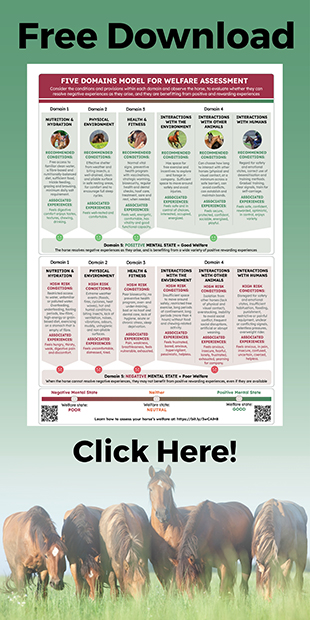
This is where welfare frameworks such as the Five Domains move from abstraction to application. Domains one to four — nutrition, environment, health, and behavioural interactions — matter because together they shape the horse’s mental state. The question is not simply whether negative experiences exist, but whether horses can identify them, resolve them, and access genuinely positive experiences.
In Ashton’s words, good practice should “leave horses better” — not just trained, tired, or tolerated, but more secure in their expectations of the world.
Optimism grounded in practice
What makes Ashton’s message resonate is not just its coherence, but its optimism. Throughout the webinar, she shares examples from riding schools and equestrian centres where small, thoughtful changes — from social contact and choice, to clearer communication and cleaner releases — are already reshaping horses’ lived experience.
These are not grand gestures. They are cultural signals. And they demonstrate that welfare horse sports are not a distant ideal, but an emerging reality when knowledge, ethics, and practice are allowed to align.
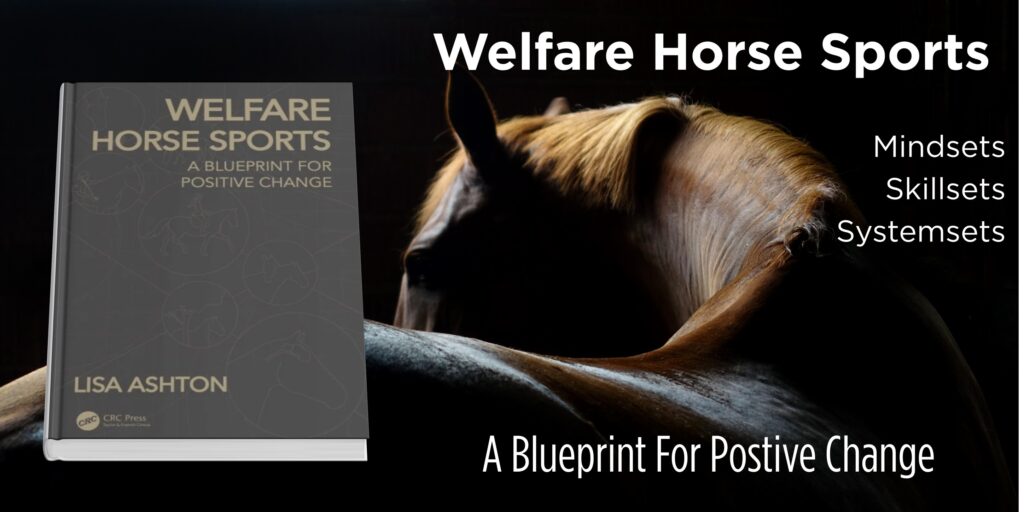
That alignment is the heart of Ashton’s newly released book, Welfare Horse Sports: A Blueprint for Positive Change, which expands on the ideas introduced in the webinar. The blueprint is not about abandoning equestrianism, but about future-proofing it — keeping what works, updating what doesn’t, and doing so in community.
Because, as this webinar made clear, trust is rebuilt not through slogans or silence, but through cultures that consistently show — even when no one is watching — that horses truly matter.
Learn more about the ABRS+ Future Riding Schools Project that Lisa is leading by clicking here