
Ask a farrier what’s wrong with your horse and the answer starts in the feet. Ask a nutritionist and it starts in the feed bucket. Ask a bodyworker and it starts in the back. Ask a vet who specialises in metabolic disorders and within five minutes you’re talking about insulin.
This can be funny because it is true. But it is true because it’s biology.
We tend to think of expertise as expanding what we see. And although it certainly does that, it also narrows it.
The farrier has spent years training their eye, their hands, and their instincts around hoof capsule geometry, breakover, and load distribution. Their nervous system has been calibrated by thousands of repetitions of detecting, interpreting, and responding to hoof-related signals. That calibration is what we call expertise and skill. It is real, physical, and largely unconscious. Each time they look at a horse they can’t help but deploy the perceptual system they’ve invested so long in calibrating.
Relying on those skills is no flaw. It is exactly how learning works in any living system, whether it is human, horse, or otherwise.
Every living system is built to detect what matters to them
Horses, like all animals, are organised around a set of biological goals inherited from their evolutionary history: find forage and water, maintain safe body temperature, avoid injury, stay connected to the group, reproduce, take care of young.
Every regulatory system in the horse’s body, whether it is digestive, circulatory, immune, neurological, or musculoskeletal, is part of the horse’s teleonome, and is oriented around pursuing those goals.
When something changes, detection systems fire, evaluation kicks in, a response is chosen and mobilised, and the outcome updates what the system expects next time. Scientists call this the DEFR+U cycle: Detect, Evaluate, Forecast, Respond, and Update.
This cycle runs constantly, in every living system, at every level from the cell to the whole animal. And much of it happens automatically, without conscious awareness.
But here is the part that tends to surprise people: you are doing exactly the same thing.
Your teleonome is showing
When you walk out to the paddock and scan your horses, you are running your own DEFR+U cycle. Your senses and nervous system are scanning your horses and their environment for changes, flagging what seems different, evaluating whether it is a positive (an opportunity) or a negative (a threat), forecasting its consequences, and deciding whether a response is required.
This happens faster than conscious thought. It happened before you knew anything about horses, and it has been refined and calibrated by every horse-related experience you’ve had since.
The changes that your teleonome flags as significant depend on what it has been trained to treat as relevant – through experience, knowledge, and accumulated outcomes. And the sum of what your biology has learned to pay attention to about your horses becomes your reference frame as an observer of horses.
Over time, the nutritionist has updated their priors through thousands of DEFR+U cycles in which feeding problems were the detected issue, and feeding solutions were the response. Their forecasting system has learned that when something is wrong with a horse they should first look at the diet. That prior is not wrong. It is efficient and it has been earned.
However, every strong prior is also a blind spot for whatever it has not learned to see.
We see what we believe, and we miss what we don’t
There is a well-documented tendency in human perception known as confirmation bias. From a biological perspective it is better understood as the DEFR+U system working exactly as it is meant to:
- We detect what our priors have weighted as important.
- We evaluate new information through the filter of what past outcomes have taught us to expect.
- We update when the outcome confirms our forecast and,
- we are (all of us, without exception), slower to update when it doesn’t confirm our forecast.
The body worker who is deeply knowledgeable about ECVM (equine cervical vertebrae malformation), will notice subtle asymmetries in conformation and movement, reluctance to bend, and other patterns that an ECVM-naïve person would miss entirely – regardless of how good they are in detecting other health problems. That ECVM-calibrated eye is a genuine gift to affected horses in their care. But it mat be slower to flag a social isolation, nutrition, hoof-related problem, or the early signs of a pain response that doesn’t fit the pattern they expect.
It is not because they don’t care, but because their system hasn’t tuned to those frequencies with the same resolution.
What a structured welfare assessment actually does
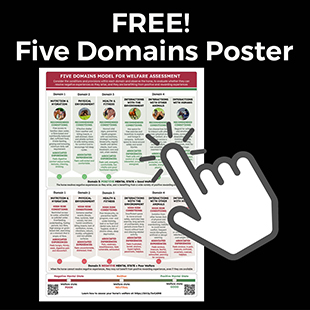
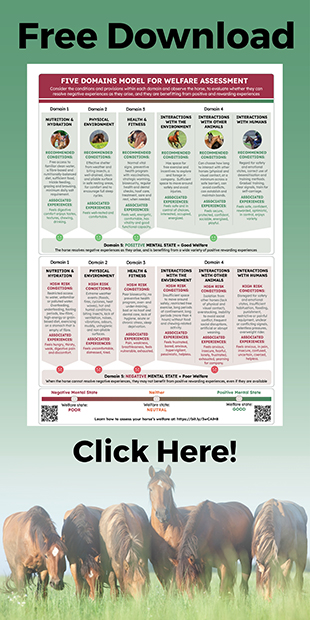
This is precisely why a structured welfare assessment process that covers all Five Domains matters — not as a replacement for expertise, but as a corrective to its inevitable narrowing. A process that moves systematically across the full range of a horse’s regulatory systems: nutrition, physical environment, health, behaviour, and social life, asks the observer’s detection system to scan all frequencies, not just those you are most experienced and interested in.
Rather than eliminate what you’ve become an expert in seeing, it will ask you to look beyond it.
Becoming an expert in everything is neither possible nor desirable. Your special areas of interest and hard earned expertise are real and valuable. The aim should be to hold them alongside a wider frame: one that starts with the whole horse, follows the biology, and keeps the animal’s experience (rather than your area of specialisation) at the centre of what you’re trying to understand.
The horse in front of you is running every bio-regulatory cycle simultaneously. The question is whether your welfare assessment is wide enough to meet them there. This is the logic of teleonomic welfare assessment.
References:
Mellor, D. J., Beausoleil, N. J., Littlewood, K. E., McLean, A. N., McGreevy, P. D., Jones, B., & Wilkins, C. (2020). The 2020 five domains model: Including human–animal interactions in assessments of animal welfare. Animals, 10(10), 1870. https://www.mdpi.com/2076-2615/10/10/1870
Wilkins, C. L., Henshall, C., Lykins, A. D., Mellor, D. J., Fillios, M., & McGreevy, P. D. (2026). The teleonome: a framework for understanding animal welfare integrating adaptive capabilities, affective regulation, agency, and environmental affordances. Frontiers in Animal Science, 7, 1768519. https://www.frontiersin.org/journals/animal-science/articles/10.3389/fanim.2026.1768519/full